
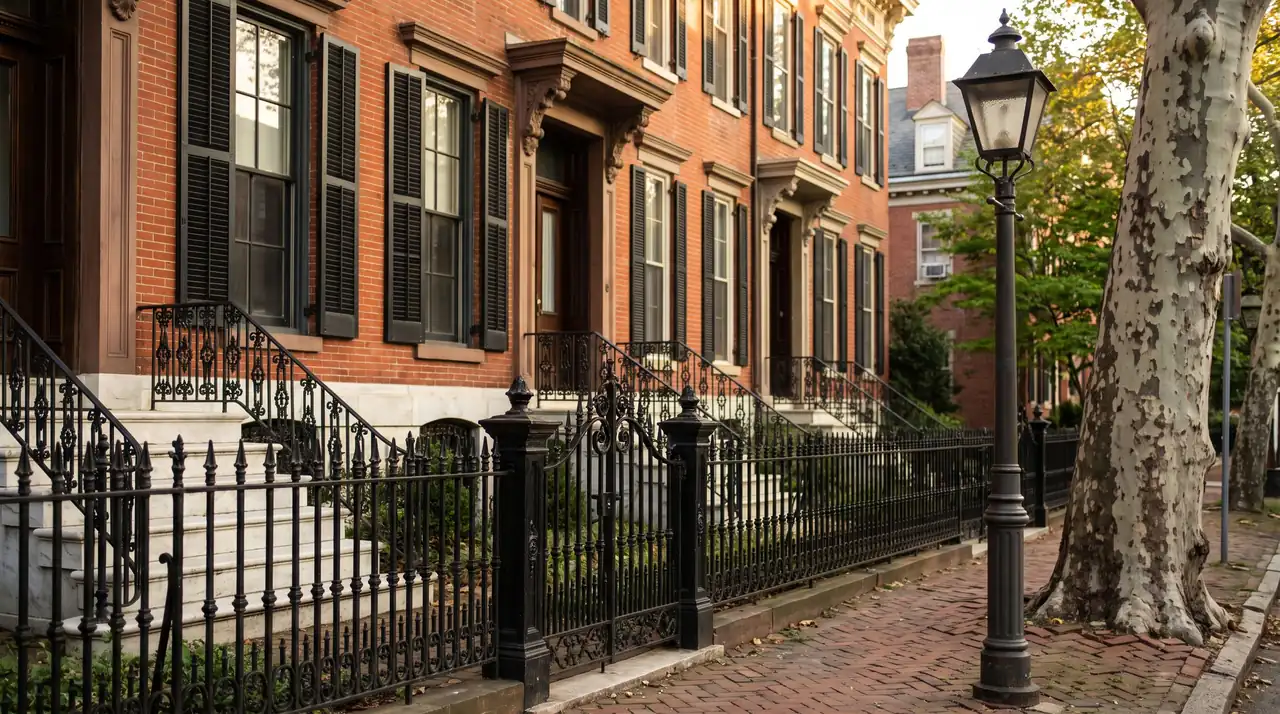
Short answer: In the West Chester Downtown Historic District in West Chester, PA, a fence visible from the street may need review by the borough’s Historical and Architectural Review Board (HARB) on top of the $50 zoning review. The borough’s published materials do not settle exactly which fences HARB must see, so we check with the borough before ordering anything.
The district covers much of the borough’s older core, and the borough oversees changes there through HARB, which issues Certificates of Appropriateness for work in the district. Fences sit right at the edge of that system: they are small, but they front brick sidewalks and Italianate façades. This guide explains what HARB is, what is known about how it treats work like fencing, and which fence designs tend to sit comfortably on a historic street.
- District: West Chester Downtown Historic District, listed on the National Register July 2, 1985; boundary expanded February 27, 2005; about 521 acres.
- Scale: roughly 3,137 contributing buildings, built from 1789 into the 1930s.
- Approval: HARB issues Certificates of Appropriateness (COA); the application is linked from the borough’s Building Permits page.
- Zoning review: fences also go through the borough’s $50 zoning review.
- Unconfirmed: whether every fence needs a COA, or only those visible from a public way. Ask the borough.
What is HARB in West Chester, PA?
HARB is the borough’s Historical and Architectural Review Board, which reviews exterior changes in the historic district and issues Certificates of Appropriateness.
Published HARB minutes show the board reviewing façades, windows, roofing, siding, signs and awnings. It meets roughly monthly and can approve an application, approve it with conditions, request revisions, or table it for more information. That matters for scheduling: an application that needs a second look can add a month or more before work can begin. The borough’s Building Permits page links both the HARB Certificate of Appropriateness application and the Shed, Fence & Patio application.
Does a fence in the historic district need HARB approval?
It may. We could not confirm from the borough’s published guidance whether fences always require a COA, so treat any fence visible from the street as a likely candidate for review.
The practical approach is to ask before buying materials. When 76 FENCE West Chester takes on a historic-district project, we confirm with the borough whether the planned fence needs HARB review, and if it does, we prepare the drawings, material samples or product sheets, and photos the board is likely to want. A rear-yard fence tucked behind a rowhome may be treated differently from a front fence along High Street, but that is the borough’s call, not ours.
What the district is made of
The borough’s 2003 preservation inventory counted 441 Italianate buildings, the largest single style, along with Federal (224), Greek Revival (222), Gothic Revival (174), Queen Anne (276) and Colonial Revival (278). Most are brick, with stucco and wood behind, and some use the green serpentine stone quarried nearby. Most are attached: the borough counts 1,439 twins and 1,040 rowhouses against 649 singles. A fence here is usually short, narrow and seen up close.
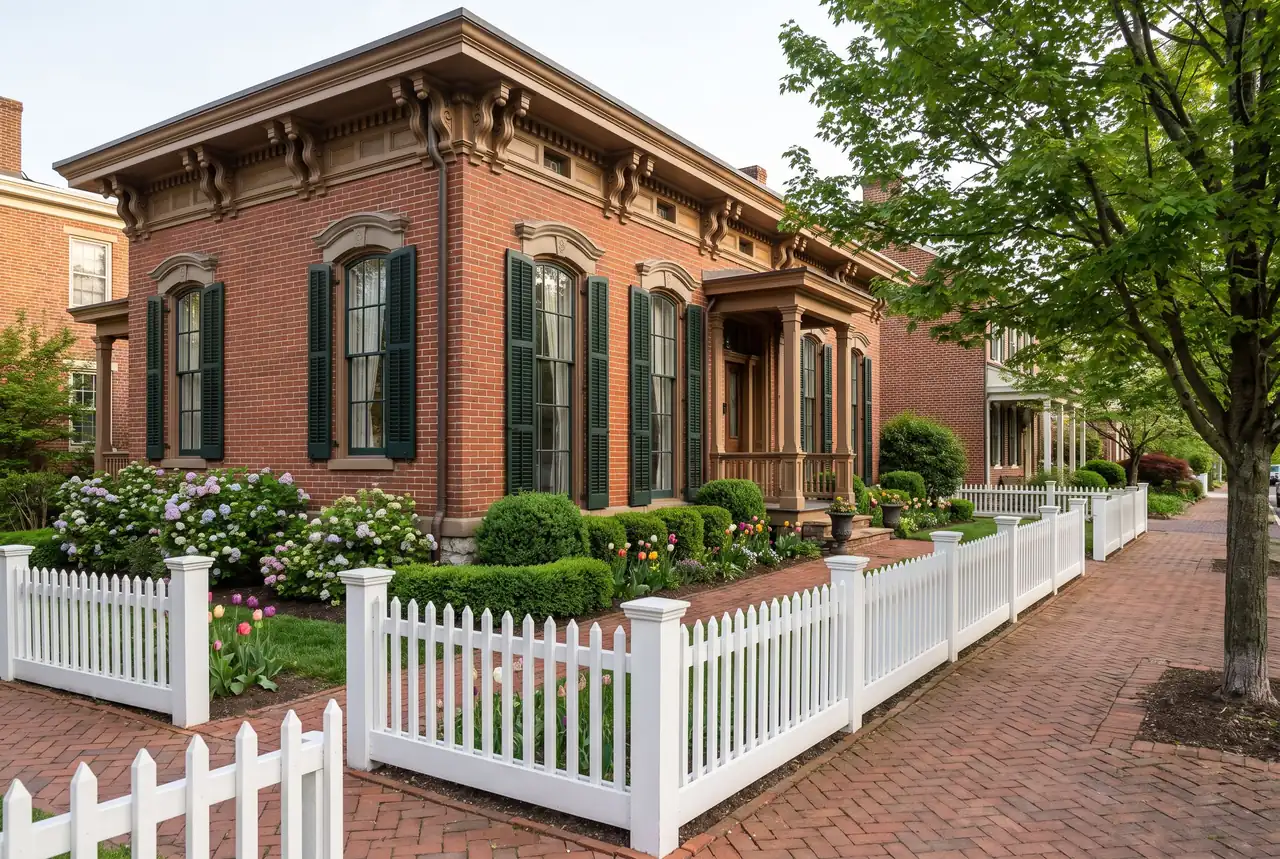
Which fence styles suit a historic West Chester street?
Painted wood picket, and metal fences that read like wrought iron, are the choices most often seen as compatible with 19th-century houses.
Across Pennsylvania, local review boards commonly favor traditional materials facing a historic street and are often skeptical of vinyl or chain link out front. That is a general pattern rather than a confirmed West Chester rule, so the specifics belong in your conversation with the borough. Here is how the usual options compare on a historic façade:
| Option | Historic character | Upkeep | Notes for the district |
|---|---|---|---|
| Painted wood picket | Traditional for Federal and Italianate fronts | Repaint periodically | Picket spacing and post caps can echo the house |
| Ornamental steel | Closest to original iron | Touch-ups every few years | Heavy, substantial look; pairs with stone or brick piers |
| Black aluminum | Reads as iron from the sidewalk | Low | Lighter; does not rust; good for rentals |
| Vinyl | Modern appearance | Low | Often discouraged facing historic streets; ask first |
| Chain link | Utilitarian | Low | Generally a poor fit for a street-facing historic lot |
For the trade-offs between real steel and aluminum, see aluminum vs. wrought iron. Our picket fence and ornamental steel pages go deeper on each.
What should a HARB fence application include?
Plan to show the board exactly what will be built and where, with enough detail that it can approve without tabling.
- Photos of the property. The street façade and the section of yard where the fence will run, as they look today.
- A site sketch. Fence line, height, gate locations and distance from the sidewalk, which in the borough is often brick and has its own construction specification.
- Product details. Material, color, picket profile, post caps and gate hardware, ideally with a manufacturer sheet or sample.
- The zoning review. The $50 borough zoning review still applies, along with the corner sight-triangle rule in § 112-805.
Do the same rules apply to alley-side fences?
Possibly not, but confirm. An alley fence behind a twin is less visible than a front fence, and the borough decides whether it warrants HARB review.
Many historic-district lots back onto alleys where a solid wood privacy fence and a gate are the practical answer for trash cans, dogs and privacy. Our rowhome backyard fence guide covers those small-yard layouts, and the historic district page and borough page cover the neighborhood in general. For permits across the area, read do you need a fence permit in West Chester, PA.
Walk the fence line with us.
A free on-site estimate in West Chester, PA and the surrounding townships. We check the rules for your street, handle the permit and HOA paperwork, and call PA One Call before we dig.
Rules change, so confirm with the borough — when you hire us, we pull the permit and check on HARB review before materials are ordered.
Sources & references
- West Chester Borough — Building Permits
- West Chester Borough — Fee Schedule
- West Chester Borough — HARB minutes, May 2024
- West Chester Downtown Historic District (Wikipedia)
Codes and ordinances change. This page is general information, not legal advice; confirm requirements with your municipality.