
Short answer: 76 FENCE West Chester installs automatic driveway and farm-lane gates for estates, horse properties and businesses around West Chester, PA. The key decisions are swing or slide, how the opener gets power, and how people get in: remote, keypad or both. We also check setback and front-yard rules and handle the permit and PA One Call request.
Automatic gates make the most sense on properties where getting out of the car to open a gate is a real chore: a long lane off a township road, a horse farm with trailers coming and going, or a business lot that needs to close at night. Around West Chester, PA that describes a lot of land along the Brandywine and out toward the hunt-country townships. This page walks through how we plan one, in the order the decisions actually have to be made.
Is an automatic gate right for your property?
It is worth considering if the gate gets opened several times a day, sits far from the house, or needs to stay closed reliably for animals or security.
- Horses or livestock that must not get onto the road if someone forgets to close the gate.
- A long driveway or farm lane where the gate is out of sight of the house.
- Deliveries, farriers, trainers or contractors who need regular access without a key.
- A commercial lot, storage yard or equipment area that should close outside business hours.
- An estate entrance where you want a defined, controlled approach.
Swing or slide: which opening style fits?
Swing gates suit wide, fairly level approaches with room behind the leaves. Slide gates suit tight spaces, slopes and driveways that rise right behind the opening.
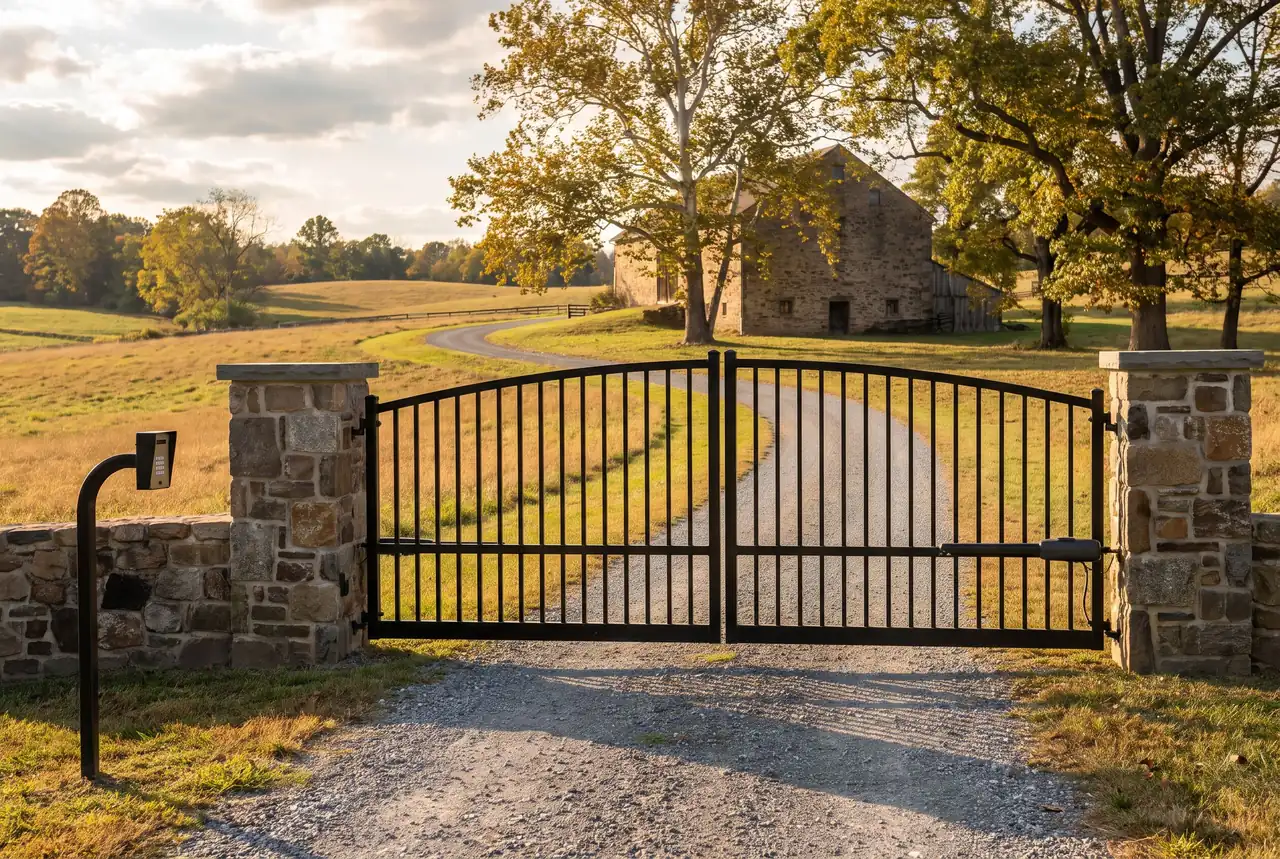
A swing gate needs clear ground for its full arc, so a driveway that climbs steeply behind the gate can stop a leaf partway. A slide gate rolls along the fence line instead, which needs a straight, clear run beside the opening roughly as long as the gate. On many farm lanes a pair of swing leaves between stone pillars is the natural choice; on a sloped commercial entrance, sliding often works better. We look at grade, snow drift and what sits beside the opening before recommending either.
What decisions go into an automatic gate?
Five, roughly in this order. Settling them early keeps the trenching, posts and opener from having to be redone.
| Decision | Options to weigh | Why it matters |
|---|---|---|
| Location | At the road, partway up the lane, near the house | Setbacks, vehicle stacking room, distance for power |
| Opening style | Single swing, double swing, slide | Grade, space beside or behind the opening |
| Gate material | Ornamental steel, aluminum, wood | Weight affects the opener and the posts that carry it |
| Power | Power run from a building, or another supply | Trenching, permits and who does the electrical work |
| Access control | Remotes, keypad, other entry devices | Who comes and goes, and how often |
How far back from the road should the gate sit?
Far enough that a car or trailer can pull completely off the road while the gate opens, and far enough to satisfy your township’s front-yard and right-of-way rules.
Codes around West Chester treat structures near the road carefully. East Whiteland allows no fence within 10 feet of the front lot line, Westtown requires front fences to sit at least 10 feet from the future right-of-way, and West Goshen bars fences in the right-of-way and in the clear sight triangle. How those rules apply to a gate and its pillars is something we confirm with the township before design. Our front-yard fence rules guide compares the limits by town.
What does installation involve?
Heavier posts or pillars, a level opening, a path for power, and careful adjustment once the opener is connected.
- Permits and utility marking. We file the township permit where required and place the PA One Call request three to ten business days before digging. Trenching for wiring makes the utility check especially important; 811 does not mark private lines, so tell us about any existing ones.
- Posts and pillars. Hinge posts on an automatic gate carry more load than a manual gate’s, so they are sized and set accordingly.
- Gate hanging. The leaf or slide panel is hung and moved by hand first to confirm it travels freely through its full range.
- Opener and controls. The operator is mounted, connected and set for travel limits and force, and access devices are programmed.
- Walkthrough. We show you manual release, remotes and keypad use, and what to check each season.
What about the fence that connects to it?
An automatic gate only controls access if the fence beside it does. On farms that is often board or post-and-rail; on estates, ornamental steel.
See our horse fence page, ornamental steel and security fencing for options that tie into a gate. For manual gates of any size, the gate installation page covers walk, drive and alley gates. Larger projects may qualify for Wisetack financing, subject to credit approval.
Walk the fence line with us.
A free on-site estimate in West Chester, PA and the surrounding townships. We check the rules for your street, handle the permit and HOA paperwork, and call PA One Call before we dig.
Sources & references
Codes and ordinances change. This page is general information, not legal advice; confirm requirements with your municipality.