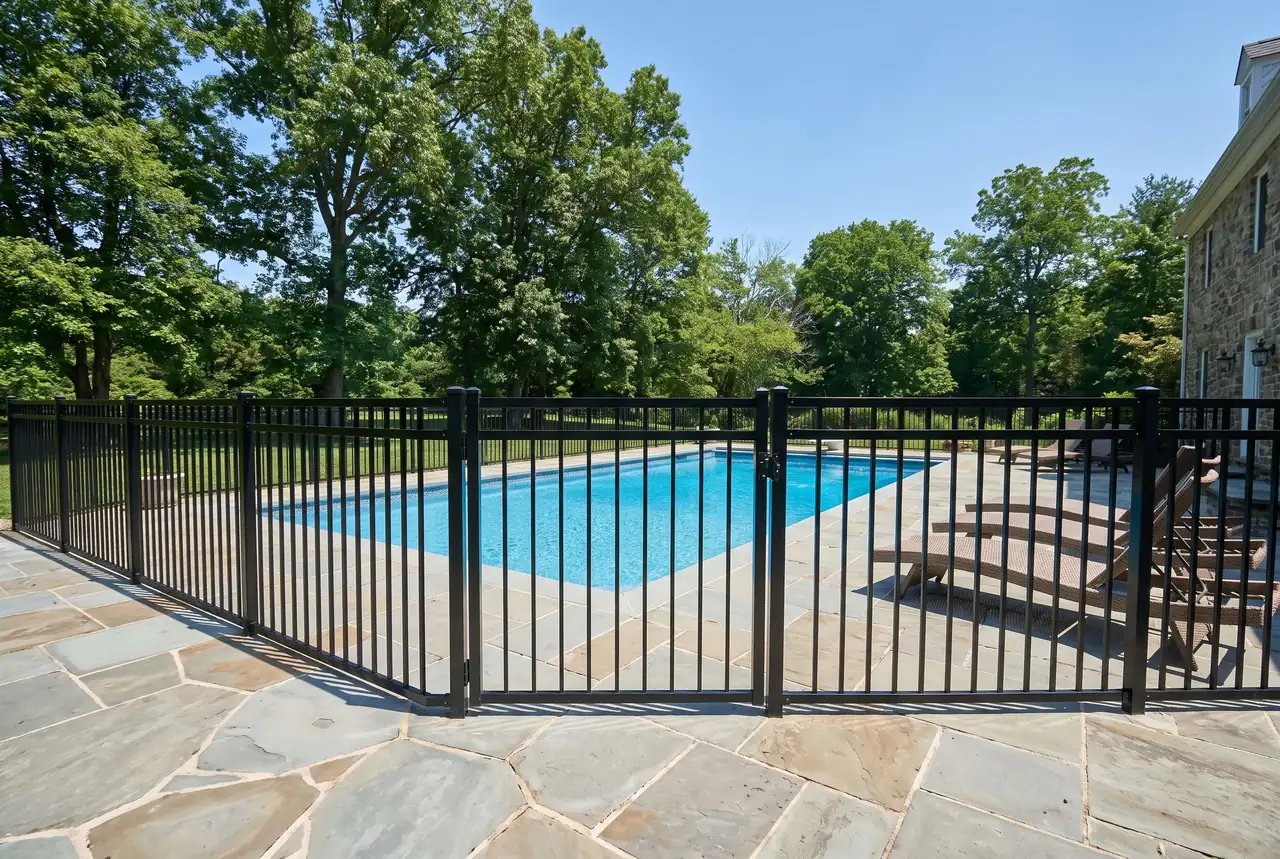
Short answer: In West Chester, PA, pool barriers follow the International Swimming Pool and Spa Code adopted through Pennsylvania’s Uniform Construction Code; the 2018 ISPSC is the edition summarized here. Key numbers: at least 48 inches tall, no opening that passes a 4-inch sphere, a bottom gap of 2 inches or less, and gates that open outward and self-close and self-latch. Some townships add stricter local rules.
A pool fence is the one fence where the measurements are set by safety code rather than taste. Inspectors check them with a tape and a 4-inch ball, and a gate that does not latch on its own will fail. This guide lists the 2018 ISPSC barrier requirements in plain terms, the extra rules some townships around West Chester layer on top, and the designs that pass most easily. Confirm the edition currently in force with your township, since Pennsylvania updates the codes it adopts.
- Height: top of barrier at least 48 inches above grade, measured on the side away from the pool.
- Openings: must not allow a 4-inch sphere to pass; chain link mesh no larger than 1¾ inches.
- Gates: open outward away from the pool, self-closing and self-latching.
- Local permits: Westtown requires a permit for any pool enclosure fence; West Goshen requires the barrier to be approved before the pool is used.
- Install time: 76 FENCE pool fences typically take 1 to 3 days on site once materials arrive.
What are the PA pool fence requirements?
Under the 2018 ISPSC, Section 305, a residential pool barrier must be at least 48 inches tall, have no openings that pass a 4-inch sphere, and use self-closing, self-latching gates that swing away from the pool.
| Requirement (2018 ISPSC § 305) | Measurement | What it means in practice |
|---|---|---|
| Barrier height | At least 48 in above grade | Measured on the outside, the side a child would approach from |
| Gap at the bottom | 2 in or less over grass or soil; 4 in or less over a solid surface | Grade the soil along the fence line before install |
| Openings in the fence | Must not pass a 4-in sphere | Pickets close enough that a small child cannot squeeze through |
| Horizontal members under 45 in apart | Must be on the pool side | Rails cannot form a ladder on the outside |
| Horizontal members 45 in or more apart | Vertical spacing 4 in or less | Tall picket sections with widely spaced rails |
| Chain link | Mesh no larger than 1¾ in | Standard 2-in mesh is too large |
| Pedestrian gates | Open outward, self-closing, self-latching | Test that the gate closes and latches from any open position |
| Latch release under 54 in high | On the pool side, at least 3 in below the top | Small openings near the latch are also limited (verify the exact detail with your inspector) |
Do townships around West Chester add their own pool fence rules?
Several do. Your township’s code applies on top of the state code, and where it is stricter, it controls.
West Chester Borough’s § 112-903B requires pools to be fenced with good-quality materials maintained in a good, safe condition. Westtown requires a permit for any pool enclosure fence under § 170-1505 and a continuous pool-code compliant barrier under § 170-1611. East Bradford’s guidance calls for a pool fence at least 4 feet tall, non-climbable, with a self-latching gate. Chadds Ford requires pools to be fully enclosed by a fence at least 4 feet tall with self-closing, self-latching gates (§ 135-203K). Birmingham’s § 122-100 calls for a 4- to 6-foot fence with self-locking gates and no aperture larger than 16 square inches, which is stricter than the ISPSC sphere test; confirm the current wording with the township. In West Goshen, the barrier must be approved before the pool goes into use.
The gate is where inspections fail
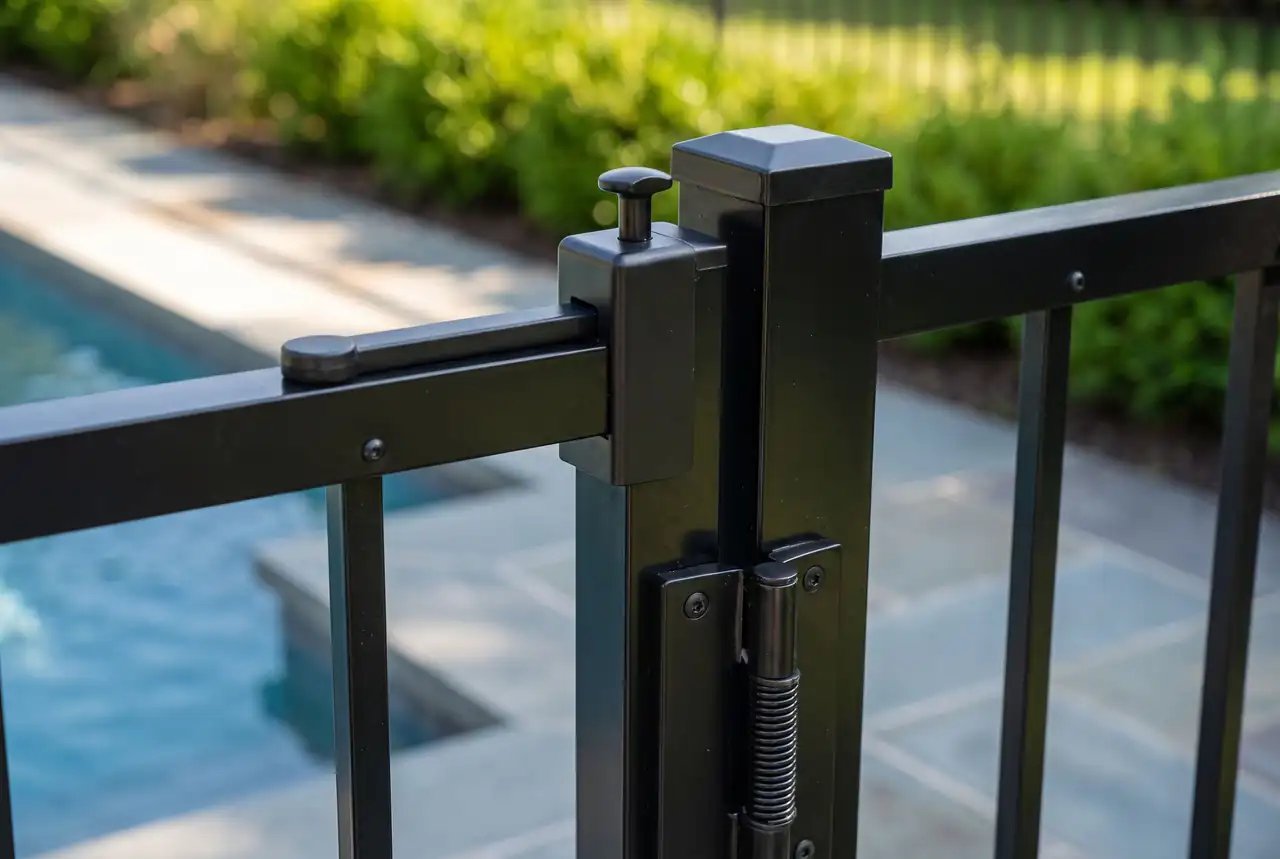
Most pool fence problems are at the gate: hinges that do not pull it shut from every position, latches that bounce open, or a gate hung to swing toward the water. Magnetic, self-latching pool latches mounted high, with the release on the pool side, solve most of these. Test the gate yourself every few weeks during swim season.
Can your house wall be part of the pool barrier?
Yes, but doors and windows in that wall then need protection, such as a UL 2017 listed alarm or another approved method.
Many pools sit close to the back of the house, and using the house as one side of the enclosure saves fence. If you do, every door opening onto the pool area must have an approved alarm or protection, and the inspector will check it. Some owners prefer a fully separate fence around the pool so the doors stay simple.
Which fence materials work best for a pool?
Black aluminum is a frequent choice: its picket spacing is built to pass the 4-inch rule, it does not rust near chlorinated water, and it keeps the pool visible.
Aluminum
Pool-rated panels with tight picket spacing and rails arranged to meet the code. See aluminum fences.
Vinyl privacy
No climbable rails on the outside when built correctly, and privacy for the deck.
Chain link
Allowed only with mesh 1¾ inches or smaller, so standard residential mesh does not qualify.
For costs, see our pool fence cost guide; for above-ground pools, see when the pool wall counts as the barrier. Our pool fence page shows designs, and local details are on the Westtown and Birmingham pages. Permit triggers by township are in our fence permit guide.
Walk the fence line with us.
A free on-site estimate in West Chester, PA and the surrounding townships. We check the rules for your street, handle the permit and HOA paperwork, and call PA One Call before we dig.
Rules change, so confirm with the township — when you hire 76 FENCE West Chester, we pull the permit and build the barrier to the code your inspector uses.
Sources & references
- Amity Township — 2018 ISPSC Section 305 barrier handout
- Westtown Township Code § 170-1611
- Birmingham Township Code
- Chadds Ford Township Code
- West Chester Borough Zoning § 112-903
Codes and ordinances change. This page is general information, not legal advice; confirm requirements with your municipality.