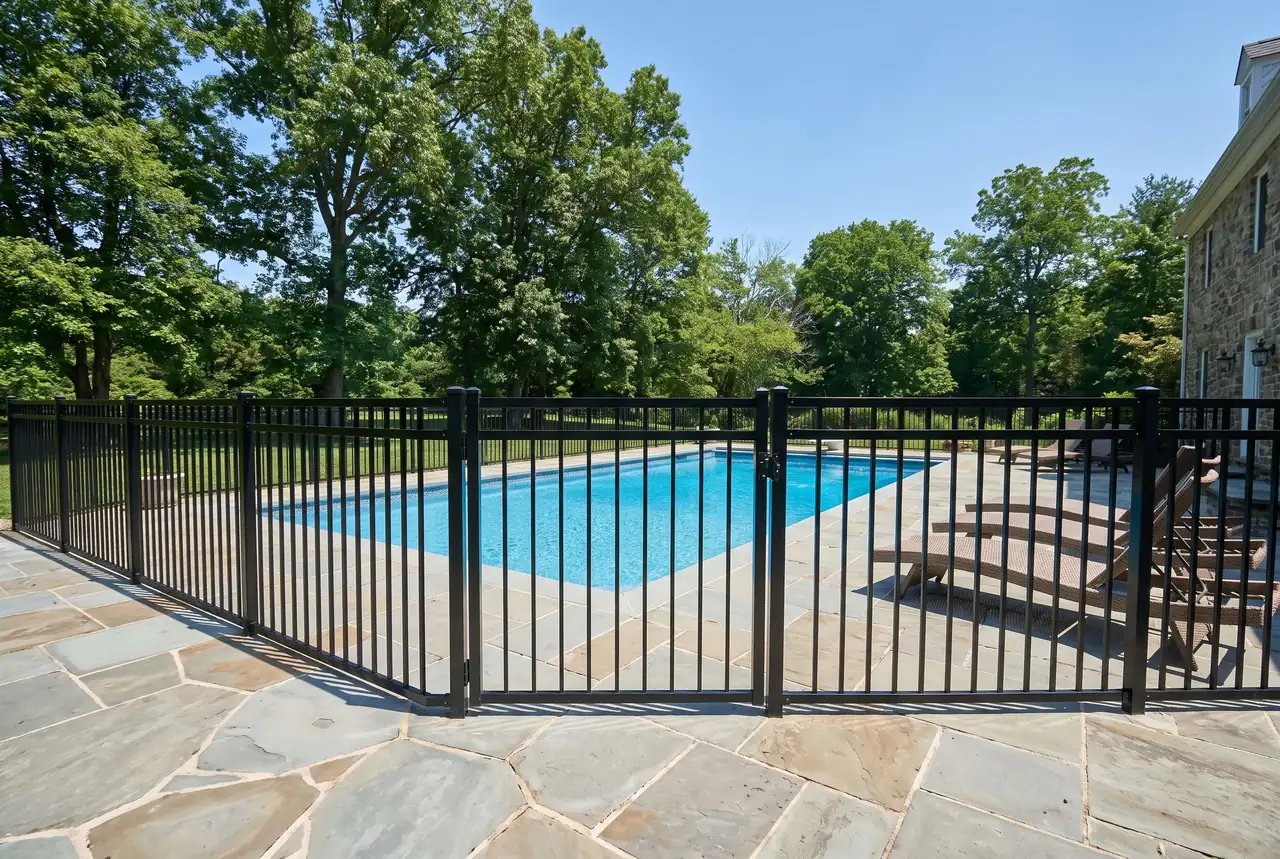
Short answer: HomeGuide’s 2026 aluminum fence guide puts aluminum pool fencing at roughly $30–$45 per installed foot nationally. Around West Chester, PA, the total also depends on code-compliant gates (self-closing, self-latching, opening outward), rock and patio edges at post locations, and the local permit, which Westtown, for example, requires for any pool enclosure fence.
A pool fence in West Chester, PA is not priced like a backyard fence, because it has to pass inspection before the pool can be used. That changes the hardware, the spacing and sometimes the layout. This page gives you published cost figures with their sources, then explains the code items that add cost. The ranges are national and are not 76 FENCE West Chester prices; your quote comes from an on-site visit.
How much does a pool fence cost per foot?
For the black aluminum fences most people choose around a pool, the published range is about $30–$45 per foot. Other materials vary.
| Pool barrier option | Published installed range per foot | Source and notes |
|---|---|---|
| Aluminum pool fence | $30–$45 | HomeGuide aluminum (2026); most common choice |
| Vinyl privacy, 6 ft | $40–$60 | HomeGuide vinyl (2026); must still meet barrier rules |
| Chain link | $9–$30 | HomeGuide; mesh must be 1¾ in or smaller for pools |
| Wrought iron | $50–$85 | HomeGuide; spacing must meet the 4-in sphere rule |
Local quotes depend on the yard, the gate count and the hardware required.
- Code: Pennsylvania’s Uniform Construction Code adopts the 2018 ISPSC for pool barriers (confirm the current edition with your township).
- Height: barrier top at least 48 in above grade, measured on the side away from the pool.
- Openings: must not pass a 4-in sphere; bottom gap 2 in or less over grass or soil.
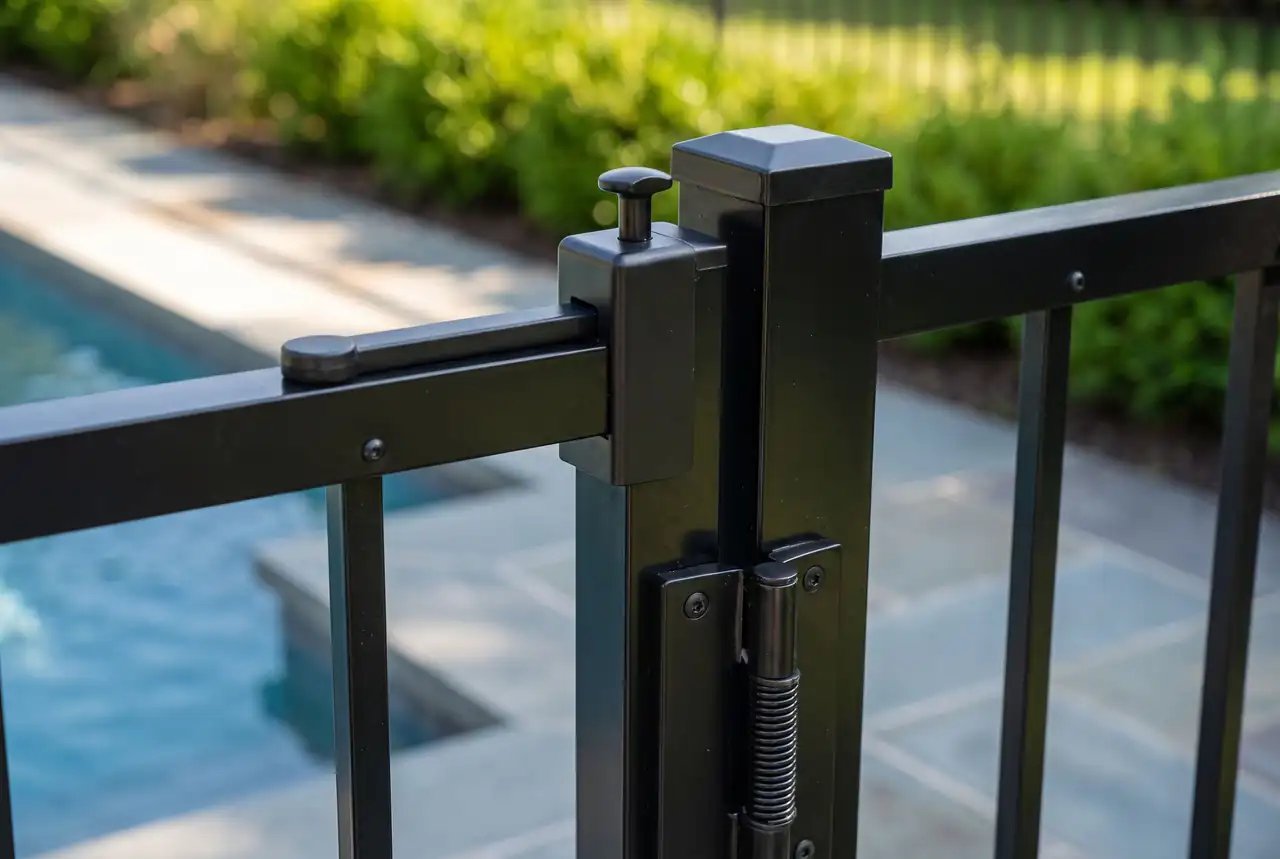
- Gates: open outward from the pool, self-closing and self-latching.
- Install time: pool fences typically take 1–3 days on site once materials arrive.
Why does a pool fence cost more than a regular fence?
The gates and the tolerances. Every pedestrian gate needs code hardware, and the fence must hold tight spacing along its whole length.
Under the 2018 ISPSC barrier rules, gates must open outward away from the pool and be self-closing and self-latching. If the latch release sits lower than 54 in above grade, it must be on the pool side and at least 3 in below the top of the gate. That usually means magnetic pool latches and spring or hydraulic closers instead of a simple gravity latch, and gate posts set firmly enough that the gate keeps closing reliably for years.
The bottom of the fence also has to stay within 2 in of grade over soil or grass. On an uneven lawn, that means more careful grading or stepping, which adds labor. Our PA pool fence code guide walks through each requirement.
Do townships near West Chester add their own pool fence rules?
Several do, and some are stricter than the state code. Check before choosing a design.
- Westtown: a permit is required for any pool enclosure fence, regardless of length, and the township calls for a continuous pool-code compliant barrier.
- Birmingham: the township’s pool section calls for a fence 4–6 ft high, self-locking gates and no opening larger than 16 square inches, which is tighter than the 4-in sphere test. Confirm the current text with the township.
- East Bradford and Chadds Ford: pools must be enclosed by a fence at least 4 ft high with self-closing, self-latching gates.
- West Chester Borough: the zoning code requires pools to be fenced and the fence kept in good, safe condition.
- West Goshen: the pool barrier must be approved before the pool is used.
Rules change, so confirm with the township — when you hire us, we pull the permit. See also our Westtown and Birmingham pages.
What site conditions change a pool fence quote?
Stone patios, rock, slopes and existing walls are the big four.
Many pool fences run along a patio edge, where posts may need core-drilling into stone or concrete rather than augering into soil. Rock under the lawn is common in the schist uplands around the borough. Sloped yards need the bottom gap kept under 2 in along the whole run. If a house wall forms part of the barrier, doors and windows opening onto the pool area need an approved alarm or other protection under the ISPSC, which is a separate cost to plan for.
Does the material change the cost of a pool barrier?
Yes, though code compliance is required whichever you pick. Aluminum is the usual choice because pool styles are built with picket spacing that passes the 4-in sphere test, the bottom rail sits close to grade, and it does not rust near chlorinated water. A solid vinyl privacy fence can also serve as a barrier and adds screening, at a higher published cost per foot. Chain link is the lowest-cost option, but pool use requires mesh no larger than 1¾ in, and many homeowners find it less attractive beside a patio. Whatever the material, if horizontal rails are less than 45 in apart they must be on the pool side so they cannot be used as a ladder.
What about above-ground pools?
An above-ground pool wall can serve as the barrier if it meets the height and climbability requirements and the ladder is removed or locked. If it does not, a deck gate or a short fence section closes the gap at a fraction of the cost of a full enclosure. See above-ground pool fences.
How do you get a pool fence price?
Book a free estimate. Our team measures, plans gate locations, checks your township’s pool rules, and files the permit. Most pool fences take one to three days on site once materials arrive. Styles are on our pool fence page and aluminum page; financing is on the financing page.
Walk the fence line with us.
A free on-site estimate in West Chester, PA and the surrounding townships. We check the rules for your street, handle the permit and HOA paperwork, and call PA One Call before we dig.
Sources & references
- HomeGuide: Aluminum fence cost (2026)
- Westtown Township § 170-1505 (fence permits)
- Westtown Township § 170-1611 (pools)
- Birmingham Township zoning (pools)
- West Chester Borough § 112-903 (pools)
Codes and ordinances change. This page is general information, not legal advice; confirm requirements with your municipality.