
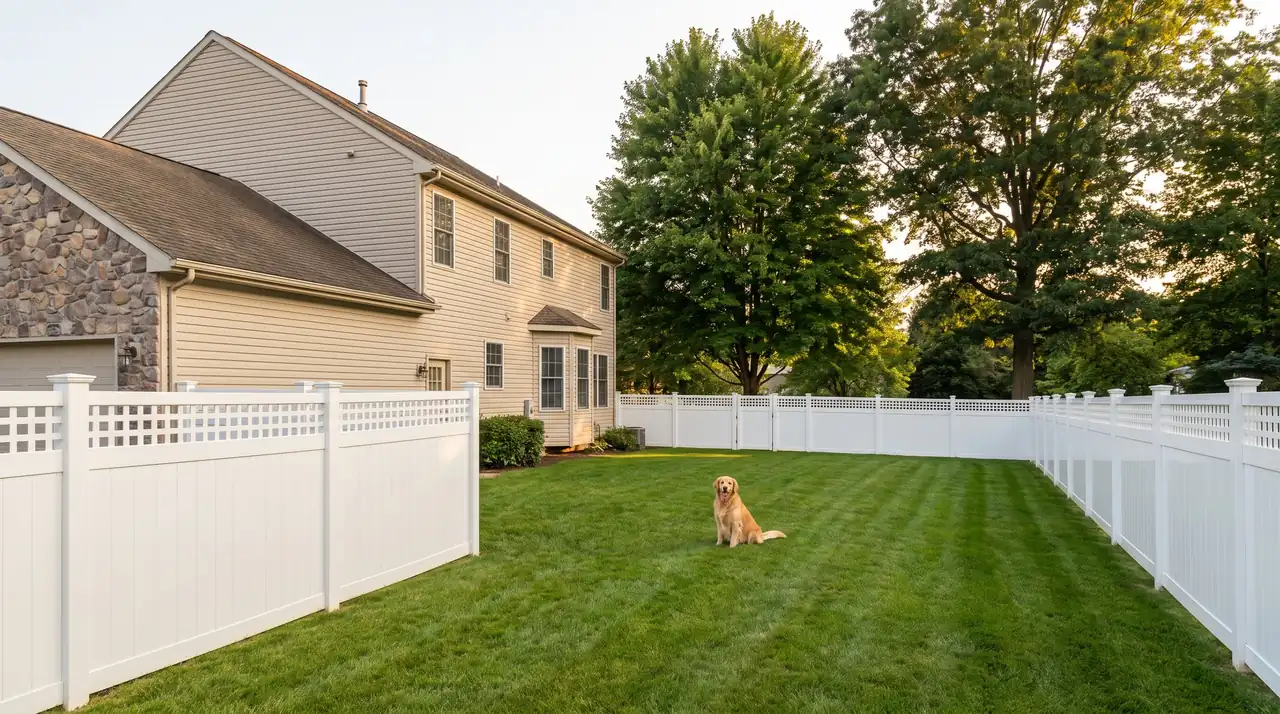
Short answer: Vinyl (PVC) is the lowest-upkeep fence for most yards in West Chester, PA. It never needs paint or stain, humidity cannot rot it, and a yearly wash keeps it clean. The trade-offs: it cannot be refinished, it gets stiffer and less forgiving of impacts in deep cold, and it can be a hard sell on a street in the historic district.
Drive through the newer neighborhoods of West Goshen or the townhome communities around Exton and you will see a lot of white and tan vinyl. 76 FENCE West Chester installs vinyl privacy, semi-privacy and picket fencing across West Chester, PA and the surrounding Chester County townships. This page covers how the material behaves in our climate, where local rules come into play, and the decisions worth making before anything is ordered.
How does vinyl hold up to Chester County winters and summers?
Well, provided the posts are set deep enough and the panels are allowed to move with the seasons. Most vinyl problems we are called to look at start in the ground, not in the panel.
Freeze-thaw is the real test here. Wet clay and schist soils freeze, expand and thaw many times between December and March, and every cycle nudges a shallow post upward until rails bind or a panel slips loose from its routed hole. Footingdepth.com notes that about 30 inches is commonly accepted in the Philadelphia area and that Pennsylvania lets each municipality set its own figure, generally between 30 and 42 inches. We set posts to whatever your township’s inspector requires, not to a one-size number.
Summer is easier on vinyl. PVC does not absorb water, so the humid July and August stretches that swell and cup wood boards leave it alone. What humidity does produce is a green or gray film on shaded faces, especially on the north side of a fence or under maples and tulip poplars. It washes off; see the fence maintenance calendar for timing.
Cold is where vinyl asks for a little care. PVC becomes stiffer in freezing weather, so the same knock from a snow-blower chute, a chunk of ice or a hockey puck that a panel shrugs off in June can split it in January. Good-quality profiles and reinforced bottom rails help, and individual pickets or panels can usually be replaced without rebuilding the run.
Color choices that age well
White is the classic choice beside a stone-front colonial. Tan and clay tones tend to hide pollen and road dust, which matters on a lot that backs onto a busy road or a farm field. Whatever color you choose, it runs through the material, so there is nothing to repaint later.
If your neighborhood has an association, the color decision may already be made for you. Ask for the architectural guidelines early.
Which vinyl style fits your yard?
Choose the style by what the fence has to do and where on the lot it goes, because township height and openness rules differ by yard.
Full privacy
Solid 6-ft panels for back and side yards. Six feet is the common residential cap in side and rear yards in townships such as West Goshen, Westtown and Thornbury. More on the privacy fence page.
Semi-privacy
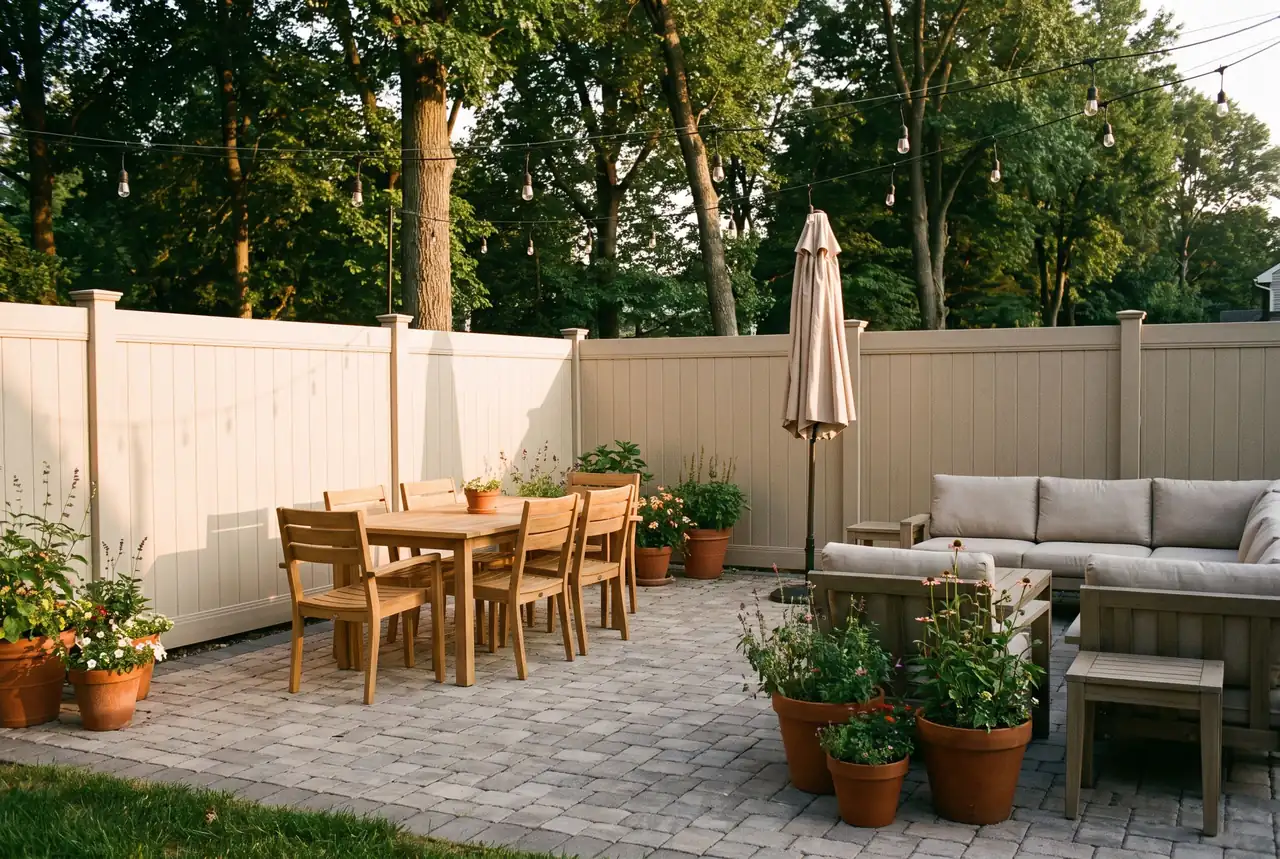
Lattice or spaced-picket tops let air and light through, which helps gardens and keeps a small rowhome yard from feeling boxed in.
Picket
Front-yard fences usually must be low and open. West Goshen, for example, allows 4 ft with at least as much open space as solid. A vinyl picket meets that intent.
Rental-ready
Landlords near campus like vinyl with a locking gate because it needs no painting between tenants. See our notes on the university area.
Can you put a vinyl fence in the West Chester historic district?
Possibly, but it is the material most likely to raise questions. Street-facing fences inside the downtown historic district may go to HARB in addition to the $50 zoning review, and vinyl is the material a review board is most likely to question, so we confirm before ordering.
Pennsylvania historical review boards commonly steer owners away from vinyl and chain link that face a historic street, and toward painted wood picket or metal that reads like iron. For the front of an Italianate or Federal house, those materials usually make the conversation easier. For a rear yard behind a twin that opens onto an alley, vinyl may be a more realistic option, but confirm with the borough first. Our HARB fence guide walks through what to bring to that conversation.
Will your HOA approve a vinyl fence?
That depends on your community’s architectural guidelines, which typically address height, material, color and style. Vinyl is often on the approved list, but the specific profile and color may be fixed.
Some townships make the association’s answer part of the permit itself. Uwchlan’s fence permit checklist, for instance, asks for an HOA approval letter where one applies. We work with you and your HOA to gather the approvals and paperwork; the HOA approval page explains how.
What does a vinyl fence cost around here?
We do not publish prices because every yard is different, but national figures give a starting point. HomeGuide’s 2026 cost guide puts 6-ft vinyl privacy at roughly $40 to $60 per installed foot nationally and vinyl picket at about $30 to $45. Local quotes depend on footage, gates, slope, rock in the post holes and removal of an old fence, and the free estimate gives you a real number. Compare the long-run picture on vinyl vs. wood, or see the vinyl fence cost breakdown.
What about warranty and upkeep?
We offer and honor manufacturer warranty coverage on every fence we install; the warranty page explains how that works. Upkeep is simple: wash the fence once a year with a soft brush and mild soap, check that gates still latch after the first winter, and keep mulch and soil from piling against the bottom rail.
Walk the fence line with us.
A free on-site estimate in West Chester, PA and the surrounding townships. We check the rules for your street, handle the permit and HOA paperwork, and call PA One Call before we dig.
Sources & references
- Footing Depth: Pennsylvania frost line
- HomeGuide: Vinyl fence cost (2026)
- Borough of West Chester: Building Permits
Codes and ordinances change. This page is general information, not legal advice; confirm requirements with your municipality.