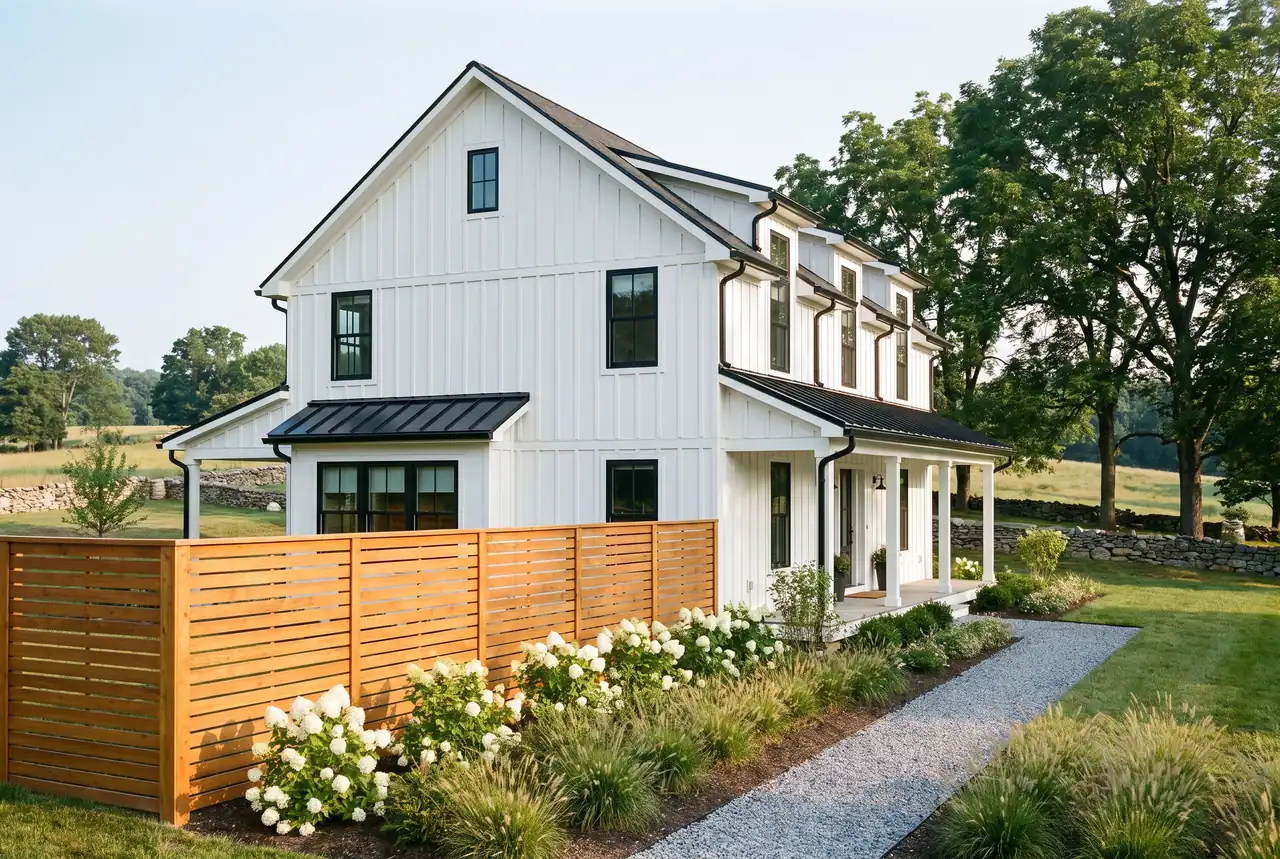
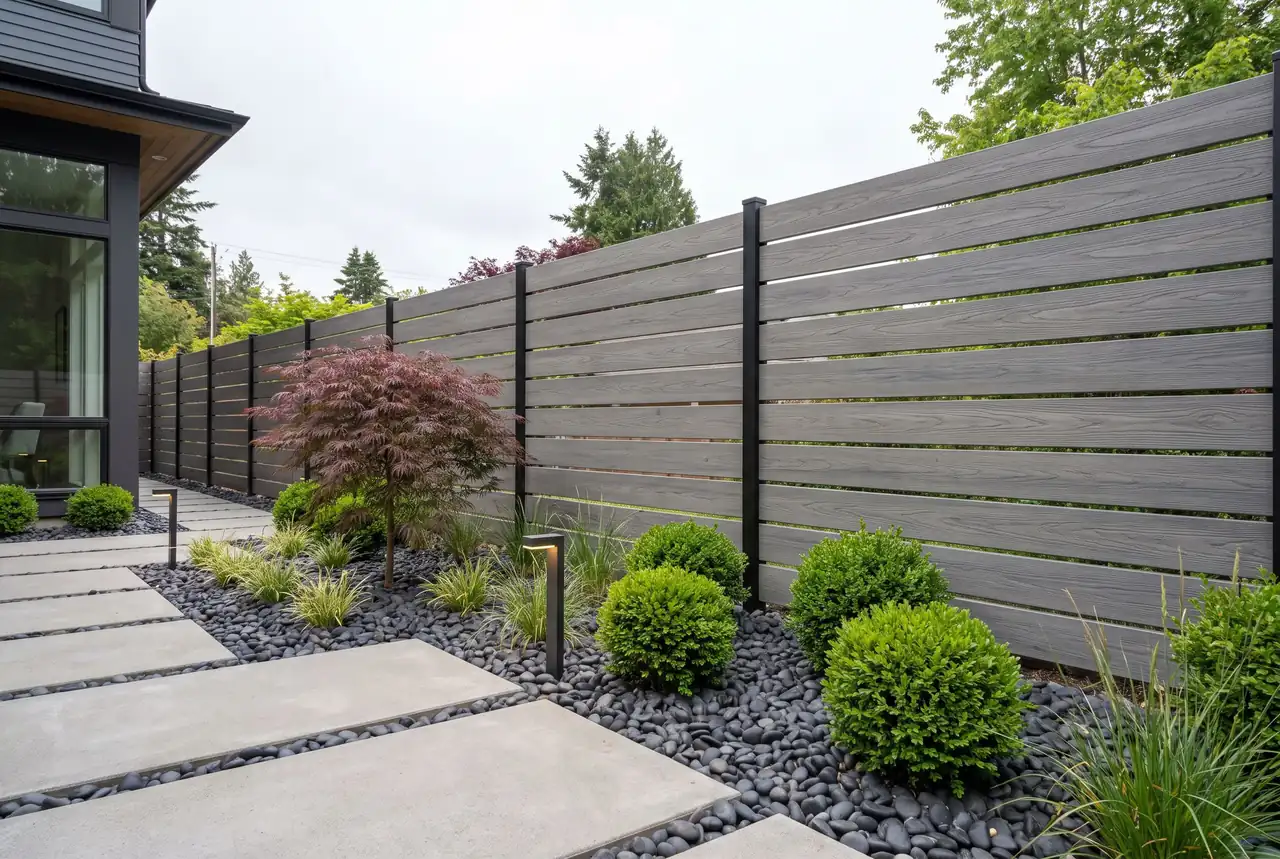
Short answer: A horizontal fence runs boards or composite slats side to side for a clean, modern look. In West Chester, PA it works best in rear yards and around patios of newer homes. It is a weaker fit for pool barriers, because horizontal rails can act as a ladder, and for front yards, where most township rules require an open fence.
Horizontal fencing has become one of the most requested looks we see around West Chester, PA, especially on newer builds, renovated ranchers and homes where the backyard has become an outdoor room. The style is mostly about proportion: long shadow lines that make a narrow yard feel wider and pair well with stone patios, dark window trim and modern landscaping. It also has some limits worth knowing before you fall for a photo.
Where does a horizontal fence look right?
On houses with strong horizontal lines of their own: contemporary builds, mid-century ranchers and split-levels, and renovated homes with dark trim. It is also a good way to screen a hot tub, patio or outdoor kitchen without fencing the whole lot.
On a Federal or Italianate brick house in the borough’s historic district, it is a harder sell. Review boards in Pennsylvania generally favor traditional styles like painted picket or iron-look metal on street-facing historic lots, and West Chester’s HARB may review a fence visible from the street. Behind the house and out of view, the question is often different. Our HARB fence guide explains what to check.
Cedar or composite for horizontal boards?
Cedar gives the warm, natural version of the look and can be stained or left to silver. Long horizontal cedar boards need a solid frame and a post spacing that keeps them from cupping or sagging, so we plan the layout around board length rather than standard panel widths.
Composite gives the same lines in a uniform gray, brown or charcoal that does not need staining. 76 FENCE’s typical guidance puts composite at around 20 years. Compare cedar fencing and composite fencing.
Can a horizontal fence be used as a pool barrier?
Usually not as a typical slatted design. Pennsylvania’s Uniform Construction Code adopts the International Swimming Pool and Spa Code, and under the 2018 ISPSC barrier rules horizontal members closer than 45 inches apart must be on the pool side of the fence.
A horizontal fence is, by design, a stack of horizontal members a few inches apart. Facing those outward gives a child a ladder, which is exactly what the rule is meant to prevent. A solid-faced horizontal design with nothing to climb on the outside can sometimes work, but most homeowners choose aluminum for the pool and keep horizontal fencing for the patio side. See pool fences and our PA pool fence code guide.
Can a horizontal fence go in a front yard?
Only if it meets the front-yard height and openness rules, and most solid horizontal designs will not. West Goshen requires front-yard fences to be 4 feet or less with at least a 1:1 open ratio. East Whiteland asks for 50 percent open, Uwchlan sets 36 inches, and Westtown allows 5 feet for open fences only.
A low horizontal fence with wide gaps between slats can be designed to meet a ratio, but that is a deliberate design, not an off-the-shelf panel. Our front-yard fence page lists the options that pass more easily.
| Location | Fit for horizontal style | Why |
|---|---|---|
| Rear yard, side yard | Good | 6 ft is the common residential limit; solid allowed |
| Patio or hot tub screen | Very good | Short runs, high visual payoff |
| Front yard | Limited | Most townships require open fences and lower heights |
| Pool barrier | Poor as typical slats | Climbable horizontal members on the outside |
Which side faces out on a horizontal fence?
The finished face, in townships that put it in code. Westtown, Thornbury and East Whiteland require the finished side toward the neighbor or the road.
Horizontal designs often hide the posts behind the boards on the outside face, which makes the inside look less finished. If you want both faces clean, we can sandwich the posts or cap them with a trim board. That costs more material but avoids looking at framing from your own patio.
How do you keep a horizontal wood fence straight?
Tighter post spacing, solid backing at mid-span where needed, and boards set with small gaps for seasonal movement. Pennsylvania’s humid summers and freeze-thaw winters move wood more than people expect.
Staining every two to three years, in line with 76 FENCE’s typical wood guidance, keeps cedar from drying unevenly. A yearly wash is enough for composite.
Many HOAs have never seen a horizontal fence in their design guidelines, so ask early; our crew prepares that paperwork and the PA One Call ticket. Township rules shift over time, so confirm with yours — once you hire us, the permit is ours to pull. Call or text 484-999-0965 to talk through board spacing.
Walk the fence line with us.
A free on-site estimate in West Chester, PA and the surrounding townships. We check the rules for your street, handle the permit and HOA paperwork, and call PA One Call before we dig.
Sources & references
Codes and ordinances change. This page is general information, not legal advice; confirm requirements with your municipality.