
Short answer: Between twins and rowhomes in West Chester, PA, a fence generally belongs to whoever built it on their own land, and a fence straddling the line is shared only if the neighbors agree. Before replacing or attaching to a shared fence, confirm the line, talk with your neighbor, and put the arrangement in writing. Borough fences go through a $50 zoning review.
West Chester Borough is mostly attached housing. The borough’s preservation inventory counted 1,439 twins and 1,040 rowhouses against 649 single homes, most on narrow lots backing onto alleys. That means many rear-yard fences run along a line shared with the house next door, often for a long time and through several owners. This guide covers who owns those fences, how to replace one without a dispute, and the layouts that work on a narrow yard.
- Housing mix: 1,439 twins, 1,040 rowhouses and 649 singles in the borough’s 2003 inventory.
- Borough review: $50 zoning review for fences; corner lots must keep the clear sight triangle (§ 112-805).
- Ownership: generally follows location and who built it, not which side faces out.
- Historic district: a fence visible from the street may also need HARB review.
Who owns the fence between two twin homes?
Usually the owner on whose land it stands. If it straddles the line, or both households built it, ownership is shared in practice and best set out in writing.
Twin and rowhome fences are often older than either current owner’s deed, so nobody remembers who built them. A survey or your plot plan, plus the location of the corner pins, will usually show which side of the line the posts sit on. If the posts are squarely on one side, that owner can generally maintain or replace the fence, ideally after telling the neighbor. If they sit on the line, treat it as shared and agree on any change together. Our survey guide explains how to find the line.
Narrow yards, alley gates
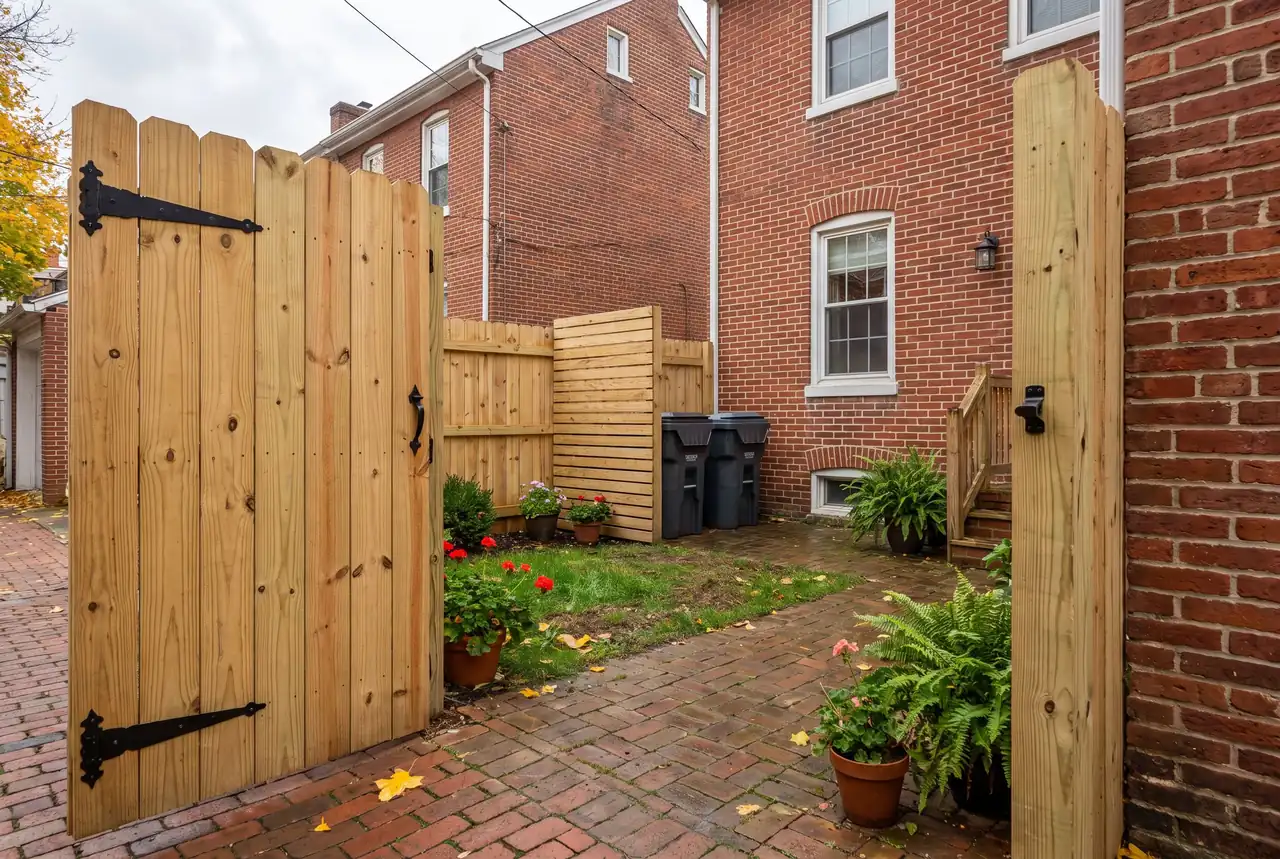
A borough rear yard typically needs three things from its fence: privacy from the neighbors on both sides, a gate onto the alley wide enough for trash and recycling bins, and a layout that does not eat the small patio. A 6-foot wood or vinyl privacy fence with a single alley gate covers all three on most lots.
How do you replace a shared fence without a dispute?
Agree on the plan before anyone removes a board: placement, style, cost and upkeep.
- Confirm where the old fence stands. On your side, on theirs, or on the line.
- Choose one of three paths. Rebuild on the line as a shared fence, rebuild a few inches inside your own line as your fence, or let the neighbor rebuild on theirs.
- Agree on style and orientation. A two-sided design such as shadowbox or vinyl privacy avoids arguments about which side gets the good face; see which side faces the neighbor.
- Write it down. Who pays, who repairs storm damage, and what happens at the next replacement.
- Get the borough review. We file the $50 zoning review and check on HARB if you are in the historic district.
Can you attach your fence to your neighbor’s fence?
Only with their permission. Attaching adds load to posts you do not own and makes later repairs everyone’s problem.
A common case is a new rear fence across the back of your yard meeting a neighbor’s existing side fence. The cleaner approach is to set your own end post beside theirs, so each fence stands on its own. The same goes for attaching to a neighbor’s house wall or garage: ask first, and expect our crew to recommend a freestanding post wherever one fits.
| Option | Ownership | Best when | Watch for |
|---|---|---|---|
| On the line, shared | Both owners | Neighbors get along and want one fence | Needs written agreement; future owners may not share it |
| Just inside your line | You | You want control of style and timing | A thin strip of your yard sits outside the fence |
| Freestanding beside an existing fence | Each owns their own | Joining a neighbor’s side fence | Two posts side by side; plan the gap for cleaning |
Material matters more on a shared line than elsewhere, because both households live with it. Vinyl needs little more than a yearly wash and looks the same from both sides. Wood costs less up front but needs re-treating every two to three years, which is easier to agree on when one owner clearly owns the fence. Either way, plan the gate hardware for daily use, since an alley gate opens far more often than a side gate in the suburbs.
What about fences between rowhomes in the historic district?
A rear fence between rowhomes may be treated differently from a street-facing fence, but in the historic district the borough decides whether HARB review applies.
See our HARB fence guide and the rowhome backyard fence guide for design ideas on small lots. For the borough in general, see our West Chester Borough page, and for alley gates, gate installation. If you are wondering whether a neighbor must pay half, read Pennsylvania fence viewers explained.
Walk the fence line with us.
A free on-site estimate in West Chester, PA and the surrounding townships. We check the rules for your street, handle the permit and HOA paperwork, and call PA One Call before we dig.
Rules change, so confirm with the borough — when you hire 76 FENCE West Chester, we pull the permit and help you plan the shared line with your neighbor.
Sources & references
- West Chester Borough — Building Permits
- West Chester Borough — Fee Schedule
- West Chester Borough Zoning § 112-805
Codes and ordinances change. This page is general information, not legal advice; confirm requirements with your municipality.