
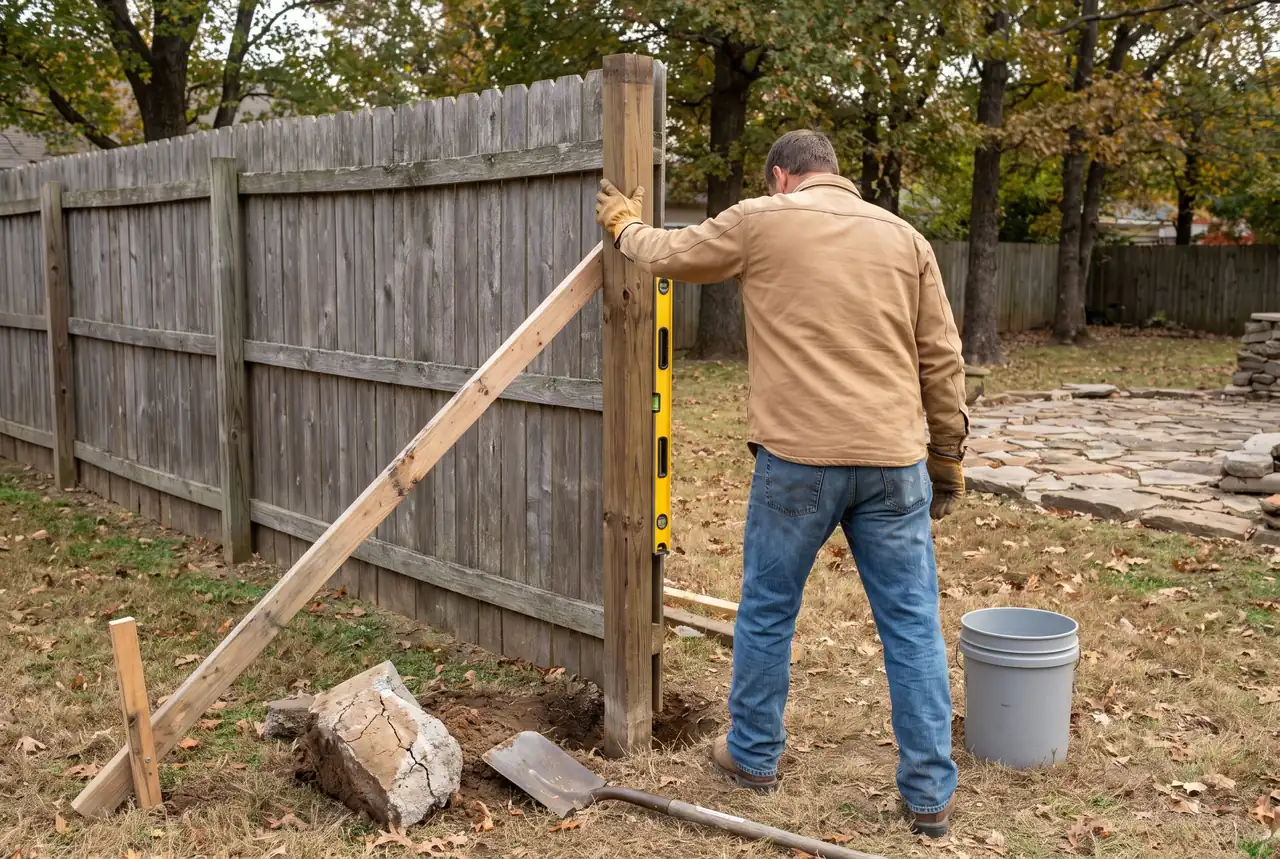
Short answer: Yes, you can usually install a fence on the limestone ground of the Chester Valley near West Chester, PA, including parts of Exton and Malvern. Fence posts are light loads, but augering can hit voids or pinnacled bedrock, and water piped onto posts can aggravate karst. Avoid known depressions, spread out downspout water, and ask the township about mapped sinkhole areas.
Most of West Chester, PA sits on hard metamorphic rock. A few miles north, the ground changes. The Chester Valley, the lowland followed by Routes 30 and 202 from Exton toward Malvern, is underlain by limestone and dolomite, and that rock dissolves slowly in groundwater. This page covers what that means for a fence, in plain terms and without overstating the risk.
What is karst, and where is it near West Chester?
Karst is ground shaped by dissolving carbonate rock. A Pennsylvania Game Commission environmental assessment, citing the EPA ecoregion description, notes that in this valley “sinkholes, underground streams, and other karst features have developed.”
The same rock produces the valley’s famously fertile Duffield and Hagerstown soils, which is why so much of it was farmed for centuries. In practice, the karst belt touches Exton and West Whiteland, East Whiteland around Malvern and Frazer, and parts of Uwchlan. The borough itself and townships to the south such as Westtown and Birmingham sit on schist instead.
- Geology: Ordovician limestone and dolomite in the Chester Valley; schist and gneiss in the surrounding uplands.
- Known activity: sinkholes widely reported along the Mariner East pipeline in West Whiteland from 2018 onward.
- Main fence concern: concentrated water at posts and voids found while augering.
- Before digging: PA One Call, 3 to 10 business days ahead.
- Who to ask: your township about mapped sinkholes or prior subsidence on your lot.
Have there been sinkholes near Exton?
Yes. WHYY and StateImpact Pennsylvania reported repeated sinkholes along the Mariner East pipeline route in West Whiteland Township, including the Lisa Drive neighborhood, beginning in 2018 and continuing in later years.
Those events were tied to heavy underground construction, which is very different from setting fence posts. Still, they confirmed what geologists already knew: the valley floor can have voids close to the surface.
It is also worth keeping perspective. Thousands of fences, decks and sheds stand on Chester Valley ground without trouble. Karst is a reason to be observant and to manage water, not a reason to give up on a fence. The homes most likely to need extra care are those with a known history of settlement, those in low spots where runoff collects, and those near large past excavations.
Can a fence cause a sinkhole?
A fence on its own is very unlikely to cause one. Posts carry little weight and disturb only a small column of soil. The real issue is water. Karst sinkholes often form where runoff is concentrated and keeps washing soil down into openings in the rock. A downspout, sump discharge or swale that empties right at a post base can, over years, make an existing weakness worse.
Simple precautions that help
- Keep downspout and sump outlets away from post lines, or extend them past the fence.
- Do not run a fence through an existing low spot, ring of cracked soil or depression in the lawn.
- Crown the concrete at each post so water sheds away instead of pooling.
- Choose open styles on lots where water must flow across the yard.
- Recheck posts after heavy storms in the first season.

What if the auger drops into a void?
Stop and reassess. If a hole suddenly loses resistance or soil keeps falling away, the post should not simply be filled with extra concrete. The usual response is to move the post along the line, change panel spacing, or bridge the spot with a longer section. Aluminum and ornamental steel are helpful here because panels can be cut to shift posts.
The opposite problem is common too: pinnacled bedrock, where solid limestone rises in irregular spires. One hole hits rock at 12 inches and the next goes down freely. Our rocky soil guide covers how crews deal with that.
Should you get an engineer involved?
For an ordinary residential fence, it is rarely needed. It becomes worth considering if your lot has active subsidence, a documented sinkhole, or a large structure like an automatic gate with heavy pillars. Townships in the valley may also have their own requirements for disturbance in karst areas; that is a question for the municipality, and we do not want to guess at it.
Heavy items deserve the most thought. An automatic driveway gate puts a swinging load on two posts or pillars, and its operator may need a concrete pad and buried conduit. On karst ground, those footings are worth discussing early, and it is reasonable to ask the township whether anything special applies to your parcel.
Do township fence rules change in the Chester Valley?
The fence rules themselves are the usual height and setback rules. West Whiteland caps fences at 6 feet in required yards, with anything above that at least 50 percent open and an absolute maximum of 12 feet. East Whiteland requires a permit for fences over 4 feet and keeps fences 10 feet back from the front lot line. Our permit guide compares townships.
The most useful step is a conversation before materials are ordered. We can plan post locations around problem spots and pair the right material with the ground, whether that is a privacy fence or open aluminum. Rules change, so confirm with the township — when you hire us, we pull the permit.
Walk the fence line with us.
A free on-site estimate in West Chester, PA and the surrounding townships. We check the rules for your street, handle the permit and HOA paperwork, and call PA One Call before we dig.
Sources & references
- West Whiteland Township Code § 325-29
- East Whiteland Township Code § 200-93
- PA One Call System — User Guide
Codes and ordinances change. This page is general information, not legal advice; confirm requirements with your municipality.