Short answer: Hitting rock while digging fence post holes is common in West Chester, PA, where the uplands sit on Wissahickon schist and gneiss. A crew usually breaks through with a rock bar, core drill or small jackhammer, or sets the post shallower with more concrete when the local inspector accepts it. Rock rarely stops a fence; it changes the method and the time.
If you have ever planted a shrub in West Chester, PA and struck a flat, glittery slab a foot down, you have met the bedrock that shapes fence work across most of the area. This page explains what is under your yard, why it matters for posts, and what the realistic options are when the auger stops turning.
What kind of rock is under West Chester yards?
Mostly metamorphic rock: schist and gneiss, with pockets of serpentine. Chester County lies in the Northern Piedmont, and the uplands around the borough and the surrounding townships are dominated by Wissahickon and Peters Creek schist.
Schist splits in layers, so post holes often turn up broken plates and loose shards rather than one solid floor. Gneiss is harder and more massive. Serpentine, the green stone that faces many older borough buildings, appears in scattered bodies, most famously in the serpentine barrens of southern Chester County. North of the borough, the Chester Valley through Exton and Malvern is a different story: limestone and dolomite, which bring their own concerns covered in our guide to sinkholes and fences.
- Typical rock: Wissahickon/Peters Creek schist and gneiss in the uplands; serpentine locally.
- Chester Valley: Ordovician limestone and dolomite, with karst features.
- Common fixes: rock bar, core drill, jackhammer, or a shallower set with more concrete if the inspector agrees.
- Before digging: PA One Call (811) at least 3 and no more than 10 business days ahead.
- Depth: set by the municipality; confirm locally rather than assuming a single number.
Does rock mean you cannot have a fence?
No. Rock changes how posts are set, not whether they can be. In nearly every case a post can be anchored solidly; the question is how much labor it takes and which method suits the spot.
The four usual methods
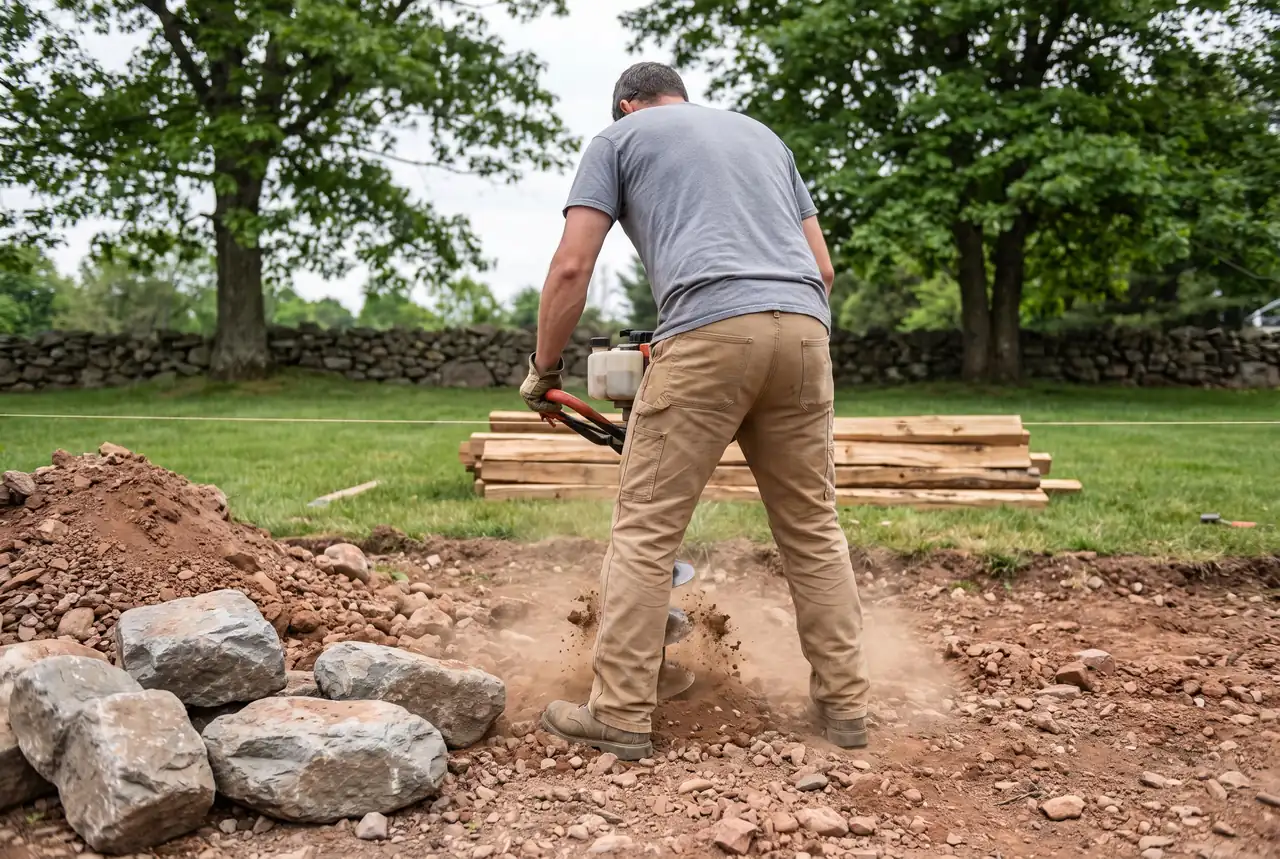
- Break it up. Layered schist often gives way to a heavy rock bar. Loose plates come out by hand and the hole continues.
- Core drill. For solid rock, a core bit cuts a clean round socket. The post sits in the socket with grout or concrete.
- Jackhammer. A small breaker opens hard ledges where a core drill is impractical.
- Shallower set, more concrete. When rock is sound and the hole cannot reasonably go deeper, a wider footing can compensate. This depends on what the local inspector will accept.
How deep should a post go if there is rock?
As deep as the municipality requires, unless the inspector allows an alternative for ledge rock. Pennsylvania lets each municipality set its frost depth, and figures in the 30 to 42 inch range appear around the state; one reference puts the Philadelphia area near 30 inches.
Because the number varies, we do not quote a single depth for every township. Our fence post depth guide explains why frost depth matters and how to confirm it for your address.
Which fences handle rocky ground best?
Fences with fewer posts, or posts that tolerate small position changes, cope best. A few practical patterns:
Aluminum and steel
Panels can be cut to shift a post a few inches off a boulder. Slim posts also mean smaller sockets when core drilling. See aluminum fencing.
Split rail
Rails slide into mortised posts, so spacing has some give. Common on rocky farm edges and wooded lots.
Vinyl privacy
Fixed panel widths leave little room to dodge rock, so every hole has to land on its mark. Expect more breaking work.
Will rock add time to the install?
Often, yes. A yard with heavy ledge can take longer than the usual day or two on site, because each stubborn hole takes extra minutes or a different tool. A walkthrough helps: probing a few spots and looking at exposed outcrops, wall stone and nearby excavation gives a reasonable sense of what is below.
Can rock damage utilities or private lines?
Breaking rock does not change the utility rules. PA One Call must be notified at least 3 and no more than 10 business days before digging, and the marked tolerance zone is 18 inches on either side of a line. The contractor who digs makes that call.
Private lines, such as an invisible dog fence wire, irrigation, landscape lighting or a feed to a shed, are not marked by 811. In rocky yards those lines are often shallow because the original installer hit the same rock, so it pays to point them out. More detail is in our PA One Call guide.
Where around West Chester is rock most common?
Hillside lots along the Brandywine in East Bradford, wooded parcels in Westtown and Birmingham, and older borough yards all turn up schist regularly. It is a general pattern rather than a map; two neighboring yards can differ.
When you hire us for a fence installation, rock is something our crew plans for, not something that surprises the schedule. Rules for depth change, so confirm with the township — when you hire us, we pull the permit.
Walk the fence line with us.
A free on-site estimate in West Chester, PA and the surrounding townships. We check the rules for your street, handle the permit and HOA paperwork, and call PA One Call before we dig.
Sources & references
Codes and ordinances change. This page is general information, not legal advice; confirm requirements with your municipality.